Medical Guidewire assembly joint
Pushing the boundaries
the Problem
Design and develop a new style of hybrid coronary guidewire joint.
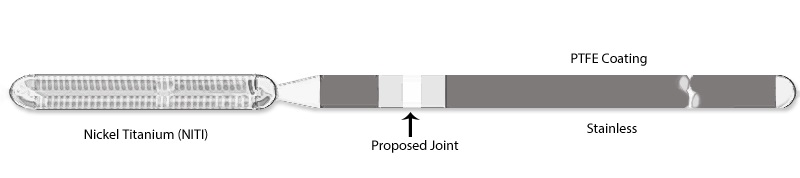 At face value, this seems straightforward, but the joint design had to deliver critical features: tensile strength, torque transfer, concentrity and a smooth bend radius between two different materials with very different properties. In addition, a lot of patents existed for joining hybrid wire sections like this together. Strategically, we wanted to avoid paying royalties; we also knew we could design a better mousetrap.
the Solution
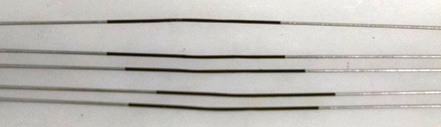
Hundreds of hours of engineering and testing yielded a great joint design.
It might look a little boring, but looks are deceiving.
 Andy whitehead sketches
Hundreds of hours of engineering and testing yielded a great joint design.
It might look a little boring, but looks are deceiving.
Andy whitehead sketches
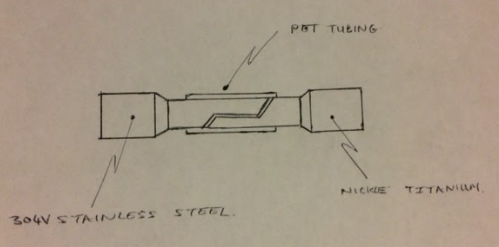
The wizardry was beneath the non descript PET (Polyethylene Terephthalate) sleeve.
Andy whitehead sketches
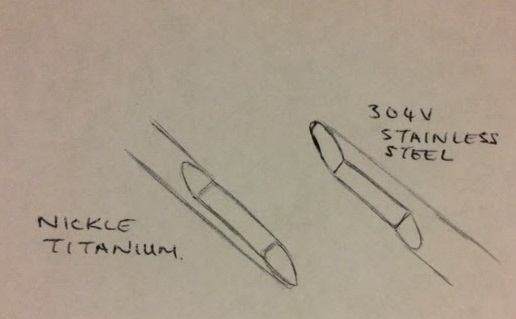
This is where the rubber hits the road. The paddle shape in each wire allowed for great torque transfer and joint strength.
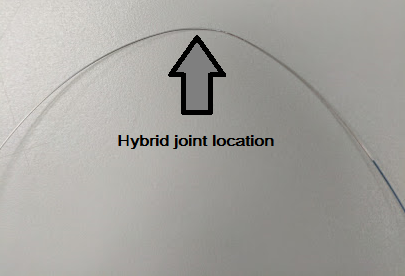
The hybrid wire looked the "part" with nice curves.
It achieved the goal of a smooth tight bend profile even with the joint at the apex of the curve, not easy to acheive.
the Outcome
This commercially viable joint was awarded a patent (Patent US 20070282270 A1), of which I was co-inventor. Ten years and 200,000 parts later, this same product is still being successfully manufactured today.